
Peptide Sciences Bio ·16 products
Regenerative & Recovery Research Peptides
Regenerative research peptides are studied for how tissue repairs itself: how new blood vessels form, how cells migrate into a wound, and how the extracellular matrix is rebuilt. BPC-157 and TB-500 are the two most researched compounds in this field, and both are available here in several sizes.
BPC-157 is a 15-amino-acid peptide derived from a partial sequence of body protection compound, a protein found in gastric juice. Its proline-rich structure gives it unusual stability, and preclinical literature has examined its interaction with VEGFR2-related angiogenic signaling, the nitric oxide system and the FAK–paxillin pathway involved in cell migration. TB-500 is a synthetic form of thymosin beta-4, a 43-amino-acid peptide that binds monomeric actin and regulates the cytoskeleton, which places it at the centre of cell migration research.
Because the two act through different mechanisms, they are frequently studied together, which is why we supply the Wolverine Stack as a pre-mixed blend alongside the individual compounds. The Glow and Klow blends extend the same approach by adding the copper peptide GHK-Cu and the anti-inflammatory tripeptide KPV. Also in this category are the TB-500 Fragment (17-23), which isolates the actin-binding region, ARA-290 for innate repair receptor research and B7-33, a single-chain relaxin analog studied in fibrosis models.
All regenerative research peptides from Peptide Sciences Bio are synthesized in-house, HPLC-MS verified above 99% purity and supplied with a batch-specific Certificate of Analysis.
Browse by research area
- Metabolic & GLP-Class Research Peptides23 products
- Growth Hormone & Growth Factor Research Peptides54 products
- Regenerative & Recovery Research Peptides16 products
- Skin, Anti-Aging & Dermal Research Peptides39 products
- Immune & Inflammation Research Peptides10 products
- Cognitive Research Peptides11 products
- Hormonal Research Peptides8 products
- Research Peptide Blends & Stacks37 products
- Bioregulator Peptides16 products
- Research Compounds11 products
- Research Supplies1 products
Showing 1–16 of 16 products
-
Regenerative
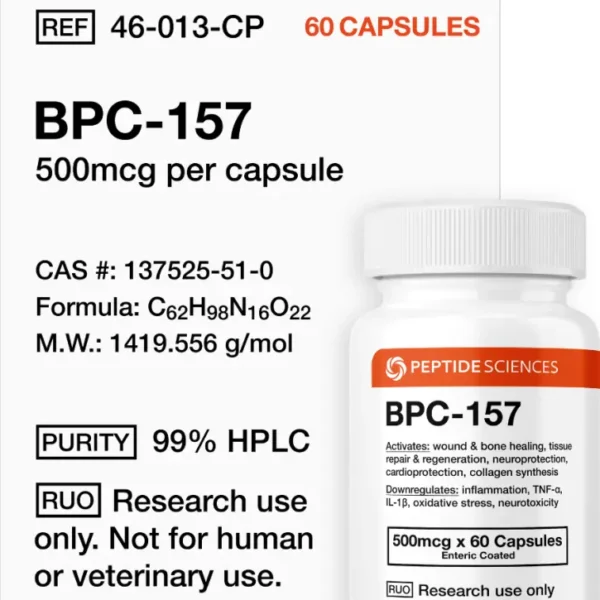
BPC 157 500mcg (60 Capsules)
BPC-157 500mcg capsules (60 count) provide a 30mg total supply of the 15-amino-acid BPC-157 peptide in a pre-measured oral capsule…
Original price was: $348.00.$299.00Current price is: $299.00. -
Regenerative
ARA-290 Peptide 16mg
ARA-290 (cibinetide) 16mg is an 11-amino-acid peptide derived from the helix B region of erythropoietin, designed to activate the innate…
Original price was: $95.00.$75.00Current price is: $75.00. -
Regenerative
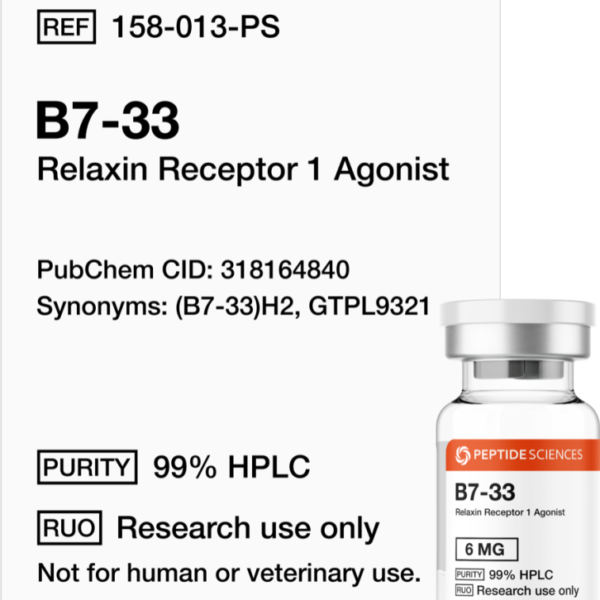
B7-33 Peptide (Relaxin Analog) 6mg
B7-33 6mg is a single-chain peptide derived from the B-chain of human relaxin-2.
$70.00 -
Regenerative
BPC-157 5mg
BPC-157 5mg is a synthetic 15-amino-acid peptide derived from a partial sequence of body protection compound, a protein found in gastric juice.
Original price was: $59.50.$49.99Current price is: $49.99. -
Regenerative
BPC-157 10mg
BPC-157 10mg is a synthetic 15-amino-acid peptide derived from a partial sequence of body protection compound, a protein found in gastric juice.
$100.00 -
Regenerative
BPC-157 15mg
BPC-157 15mg is a synthetic 15-amino-acid peptide derived from a partial sequence of body protection compound, a protein found in gastric juice.
$140.00 -
Regenerative
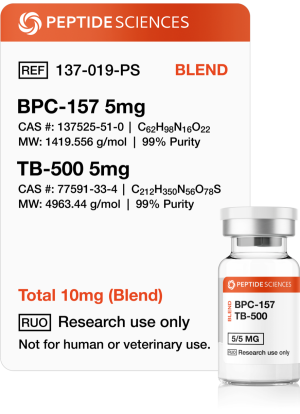
BPC-157 + TB-500-10mg (Wolverine Stack Peptide)
The BPC-157 + TB-500 10mg Wolverine Stack is a dual-peptide research blend containing 5mg BPC-157 and 5mg TB-500 in a single lyophilized vial.
Original price was: $120.00.$100.00Current price is: $100.00. -
Regenerative
BPC-157 + TB-500-20mg (Wolverine Stack Peptide)
The BPC-157 + TB-500 20mg Wolverine Stack is a dual-peptide research blend containing 10mg BPC-157 and 10mg TB-500 in a single lyophilized vial.
Original price was: $200.00.$180.00Current price is: $180.00. -
Regenerative
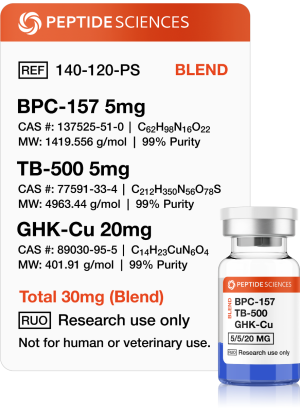
BPC-157, TB-500, GHK-Cu 30mg (Glow Blend)
The BPC-157, TB-500, GHK-Cu 30mg Glow Blend is a three-peptide research blend combining BPC-157, TB-500 and the copper peptide GHK-Cu…
Original price was: $165.00.$150.00Current price is: $150.00. -
Regenerative
BPC-157, TB-500, GHK-Cu 60mg (Glow Blend)
The BPC-157, TB-500, GHK-Cu 60mg Glow Blend is a three-peptide research blend combining BPC-157, TB-500 and the copper peptide GHK-Cu…
Original price was: $315.00.$280.00Current price is: $280.00. -
Immune & Inflammation
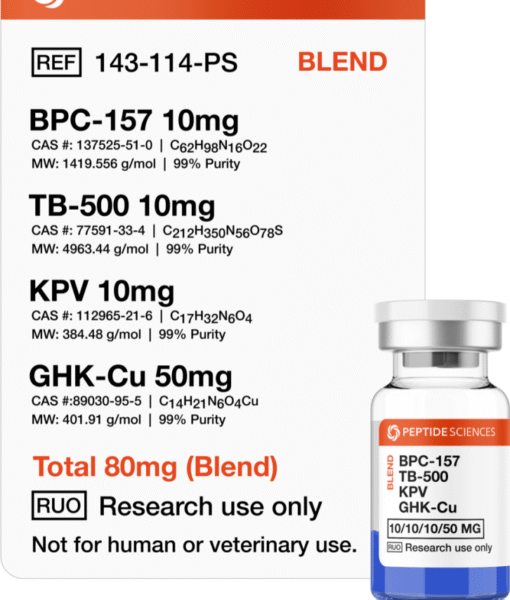
BPC-157, TB-500, KPV, GHK-Cu 80mg (Klow Blend)
The BPC-157, TB-500, KPV, GHK-Cu 80mg Klow Blend is a four-peptide research blend combining 50mg GHK-Cu with 10mg each of…
Original price was: $395.00.$345.00Current price is: $345.00. -
Regenerative
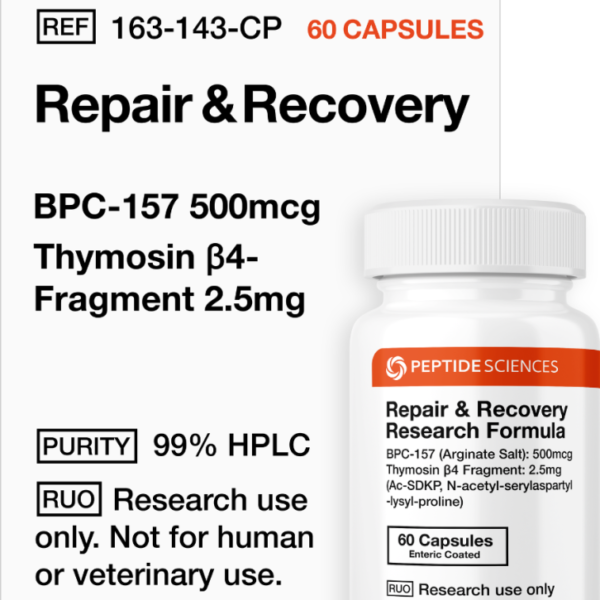
Repair and Recovery Peptide (60 Capsules) (Stable BPC-157 Arginate, Thymosin Beta-4 Fragment)
Repair and Recovery Peptide capsules (60 count) combine stable BPC-157 arginate with the thymosin beta-4 actin-binding fragment (Ac-LKKTETQ, residues 17–23)…
$300.00 -
Regenerative
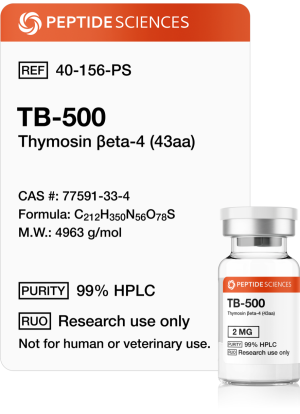
TB-500 (Thymosin Beta-4) 2mg (43aa)
TB-500 (Thymosin Beta-4) 2mg is the full-length 43-amino-acid synthetic thymosin beta-4 peptide, studied in preclinical research on actin regulation, cell…
$42.00 -
Regenerative
TB-500 (Thymosin Beta-4) 5mg (43aa)
TB-500 (Thymosin Beta-4) 5mg is the full-length 43-amino-acid synthetic thymosin beta-4 peptide, studied in preclinical research on actin regulation, cell…
$85.00 -
Regenerative
TB-500 (Thymosin Beta-4) 10mg (43aa)
TB-500 (Thymosin Beta-4) 10mg is the full-length 43-amino-acid synthetic thymosin beta-4 peptide, studied in preclinical research on actin regulation, cell…
Original price was: $165.00.$135.00Current price is: $135.00. -
Regenerative
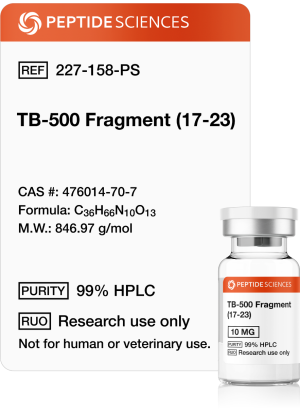
TB-500 Fragment (17-23) 10mg
TB-500 Fragment (17-23) 10mg is the seven-amino-acid actin-binding sequence of thymosin beta-4 (Ac-LKKTETQ).
$100.00







Questions
Regenerative & Recovery Research Peptides: FAQ
What is the difference between BPC-157 and TB-500?
BPC-157 is a 15-amino-acid gastric-derived peptide studied mainly for angiogenic and nitric oxide signaling. TB-500 is synthetic thymosin beta-4, a 43-amino-acid peptide studied for actin regulation and cell migration.
Why are they studied together?
They act through different mechanisms, so combining them lets researchers investigate how both pathways interact in a single experimental model. Our Wolverine Stack supplies them pre-mixed in consistent ratios.
Why does BPC-157 come in a capsule format?
Most peptides break down in the digestive tract. BPC-157 is unusual: its proline-rich sequence gives it notable stability in gastric juice, and a number of animal studies have examined it through oral routes in gastrointestinal models.
What documentation comes with each batch?
Every batch has a lot-linked Certificate of Analysis reporting HPLC purity, mass spectrometry identity, endotoxin and sterility results. You can open it before ordering in our lab results library.
All Peptide Sciences Bio products are sold for laboratory research use only and are not intended for human or veterinary use. Lab results · Reconstitution guide · Contact us