Overview
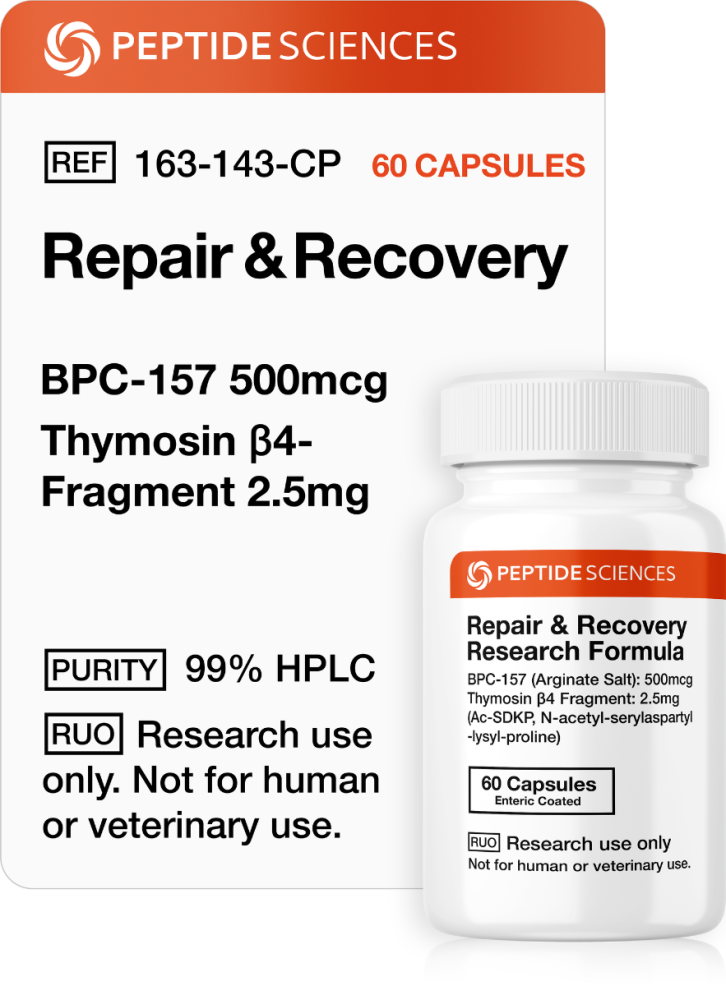
This capsule formulation pairs two peptides chosen for oral-format research. The first is BPC-157 in its arginate salt form, which has been examined for improved stability compared with the conventional acetate salt. The second is the thymosin beta-4 fragment 17–23 (Ac-LKKTETQ), the short sequence researchers have identified as the main actin-binding region of thymosin beta-4.
Peptide Sciences Bio supplies Repair and Recovery Peptide capsules, 60 per bottle, for preclinical laboratory investigation. Every batch is supported by independent analytical testing and a published Certificate of Analysis.
Product Specifications
| Product | BPC-157 arginate + Thymosin beta-4 fragment (17–23) |
|---|
| Capsule count | 60 capsules per bottle |
|---|
| Per-capsule content | See label and batch Certificate of Analysis |
|---|
| BPC-157 sequence | Gly-Glu-Pro-Pro-Pro-Gly-Lys-Pro-Ala-Asp-Asp-Ala-Gly-Leu-Val |
|---|
| Tβ4 fragment sequence | Ac-Leu-Lys-Lys-Thr-Glu-Thr-Gln (Ac-LKKTETQ) |
|---|
| Form | Capsules |
|---|
| Documentation | Batch-specific Certificate of Analysis |
|---|
Formulation Components
- BPC-157 arginate: the same 15-amino-acid BPC-157 sequence produced with an arginine counterion instead of acetate. BPC-157 is notable among peptides for its stability in gastric juice.
- Thymosin beta-4 fragment (17–23): the seven-residue LKKTETQ sequence, identified in structure-function research as the actin-binding domain of thymosin beta-4. Its small size makes it a practical tool for studying this region in isolation.
Why a Capsule Format
Most research peptides break down quickly in the digestive tract. BPC-157’s proline-rich structure gives it unusual gastric stability, and the arginate salt has been examined for further improved stability. The capsule format provides pre-measured, consistent quantities for oral-route research models.
Mechanisms Studied
- Angiogenic signaling (BPC-157): VEGFR2-related signaling and endothelial cell migration.
- Nitric oxide system (BPC-157): interactions with NO signaling.
- Actin binding (Tβ4 17–23): G-actin interaction and cytoskeletal dynamics.
- Cell migration (both): endothelial and fibroblast migration studies.
Areas of Study
- Gastrointestinal research models
- Tendon, ligament and muscle tissue models
- Angiogenesis research
- Cell migration studies
These findings come from laboratory and animal research on the individual components. Neither component, nor the combination, has been established as safe or effective in human clinical trials.
Related Research Peptides
Quality & Testing
Every batch of the Repair and Recovery capsules is independently tested for identity and purity before release. Testing includes high-performance liquid chromatography (HPLC) to confirm purity and mass spectrometry (MS) to confirm molecular identity. The batch-specific Certificate of Analysis is available on this page and in our COA library, so researchers can verify the exact material they receive.
Storage & Handling
- Store the Repair and Recovery capsules capsules in a cool, dry place, ideally at 2–8°C, in the original sealed container.
- Keep the container tightly closed and protected from light and humidity.
- Avoid repeated temperature cycling, which can introduce moisture.
- Handle using standard laboratory practices and appropriate protective equipment.
Frequently Asked Questions
What is in the Repair and Recovery capsules?
Each capsule contains BPC-157 in arginate salt form and the thymosin beta-4 fragment 17–23 (Ac-LKKTETQ). Per-capsule amounts are listed on the label and the batch Certificate of Analysis.
What is BPC-157 arginate?
It is the same 15-amino-acid BPC-157 peptide produced with an arginine counterion instead of acetate. It has been examined in research for improved stability.
How is the Tβ4 fragment different from full-length TB-500?
The fragment contains only residues 17–23 of thymosin beta-4, the main actin-binding region. Full-length TB-500 contains all 43 amino acids.
Is this product approved for human use?
No. Neither component is approved by the FDA or any other regulatory agency for human or veterinary use. This product is sold strictly for laboratory research.
How should the capsules be stored?
Store in a cool, dry place, ideally at 2–8°C, in the original sealed container, protected from light and humidity.
Research Use Only
This product is intended solely for in-vitro research and laboratory experimentation by qualified professionals. It is not a drug, food, supplement or cosmetic, and it is not intended for human or veterinary use, or for the diagnosis, treatment or prevention of any condition. Purchase is restricted to buyers who agree to our Terms of Sale.