Overview
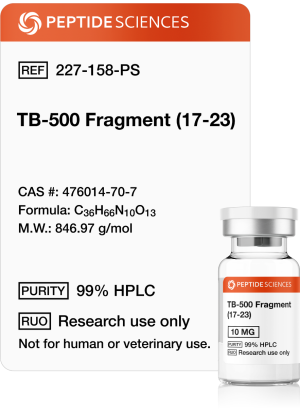
TB-500 Fragment (17-23) is a synthetic seven-amino-acid peptide corresponding to residues 17–23 of thymosin beta-4. Structure-function research has identified this LKKTETQ sequence as the actin-binding domain responsible for many of thymosin beta-4’s studied activities. Because it is much smaller than the 43-amino-acid parent peptide, the fragment lets researchers examine this specific region in isolation.
Peptide Sciences Bio supplies TB-500 Fragment (17-23) 10mg as a high-purity lyophilized powder for in-vitro and preclinical laboratory investigation. Every batch is supported by independent analytical testing and a published Certificate of Analysis.
Product Specifications
| Product | Thymosin beta-4 fragment 17–23 |
|---|
| Quantity | 10mg per vial |
|---|
| Sequence | Ac-Leu-Lys-Lys-Thr-Glu-Thr-Gln (Ac-LKKTETQ) |
|---|
| Length | 7 amino acids |
|---|
| Molecular weight | ≈889.0 g/mol (N-acetylated) |
|---|
| Form | Lyophilized powder |
|---|
| Purity | ≥99% (HPLC) |
|---|
| Documentation | Batch-specific Certificate of Analysis |
|---|
Structure & Origin
Full-length thymosin beta-4 contains 43 amino acids. Within it, the central LKKTETQ motif binds monomeric actin. Researchers studying which parts of the parent peptide drive its activity have found that this fragment reproduces several of its actin-related effects in experimental models. N-terminal acetylation mirrors the acetylated parent peptide and is commonly used to improve stability.
Mechanisms Studied
- G-actin binding: interaction with monomeric actin and its role in cytoskeletal dynamics.
- Endothelial cell migration: cell-culture studies of migration and tube formation.
- Angiogenesis: blood vessel formation in experimental wound models.
- Structure-function mapping: use as a tool to separate the actin-binding activity of thymosin beta-4 from its other regions.
Areas of Study
- Dermal wound models
- Angiogenesis research
- Cell migration studies
- Thymosin beta-4 structure-function research
These findings come from laboratory and animal research. This fragment has not been established as safe or effective in human clinical trials.
Fragment vs. Full-Length TB-500
Full-length TB-500 (thymosin beta-4) includes regions beyond the actin-binding motif, such as the N-terminal Ac-SDKP sequence studied in fibrosis research. The 17–23 fragment isolates the actin-binding region only. Researchers often choose between them depending on whether they want to study the whole molecule or this single functional domain.
Related Research Peptides
Quality & Testing
Every batch of TB-500 Fragment (17-23) is independently tested for identity and purity before release. Testing includes high-performance liquid chromatography (HPLC) to confirm purity and mass spectrometry (MS) to confirm molecular identity. The batch-specific Certificate of Analysis is available on this page and in our COA library, so researchers can verify the exact material they receive.
Storage & Handling
- Store lyophilized TB-500 Fragment (17-23) at −20°C, protected from light and moisture.
- Short-term storage at 2–8°C is acceptable for lyophilized material.
- Allow the vial to reach room temperature before opening to limit condensation.
- Handle using standard laboratory practices and appropriate protective equipment.
For laboratory solution preparation, see our Peptide Reconstitution Guide.
Frequently Asked Questions
What is TB-500 Fragment (17-23)?
It is the seven-amino-acid sequence (Ac-LKKTETQ) from residues 17–23 of thymosin beta-4, identified as its main actin-binding domain.
How is it different from full-length TB-500?
Full-length TB-500 contains all 43 amino acids of thymosin beta-4. The fragment contains only the actin-binding region.
Is TB-500 Fragment approved for human use?
No. It is not approved by the FDA or any other regulatory agency for human or veterinary use. Peptide Sciences Bio sells it strictly for laboratory research.
How should it be stored?
Lyophilized TB-500 Fragment should be stored at −20°C, away from light and moisture. Short-term storage at 2–8°C is acceptable.
What does the Certificate of Analysis include?
Each COA reports the batch number, HPLC purity results and mass spectrometry confirmation of molecular identity for that specific batch.
Research Use Only
This product is intended solely for in-vitro research and laboratory experimentation by qualified professionals. It is not a drug, food, supplement or cosmetic, and it is not intended for human or veterinary use, or for the diagnosis, treatment or prevention of any condition. Purchase is restricted to buyers who agree to our Terms of Sale.